
Your Browser is not Supported
To use aviary, please update your browser to the latest version
Download Supported Browser
or
I understand the consequences
Go to Homepage
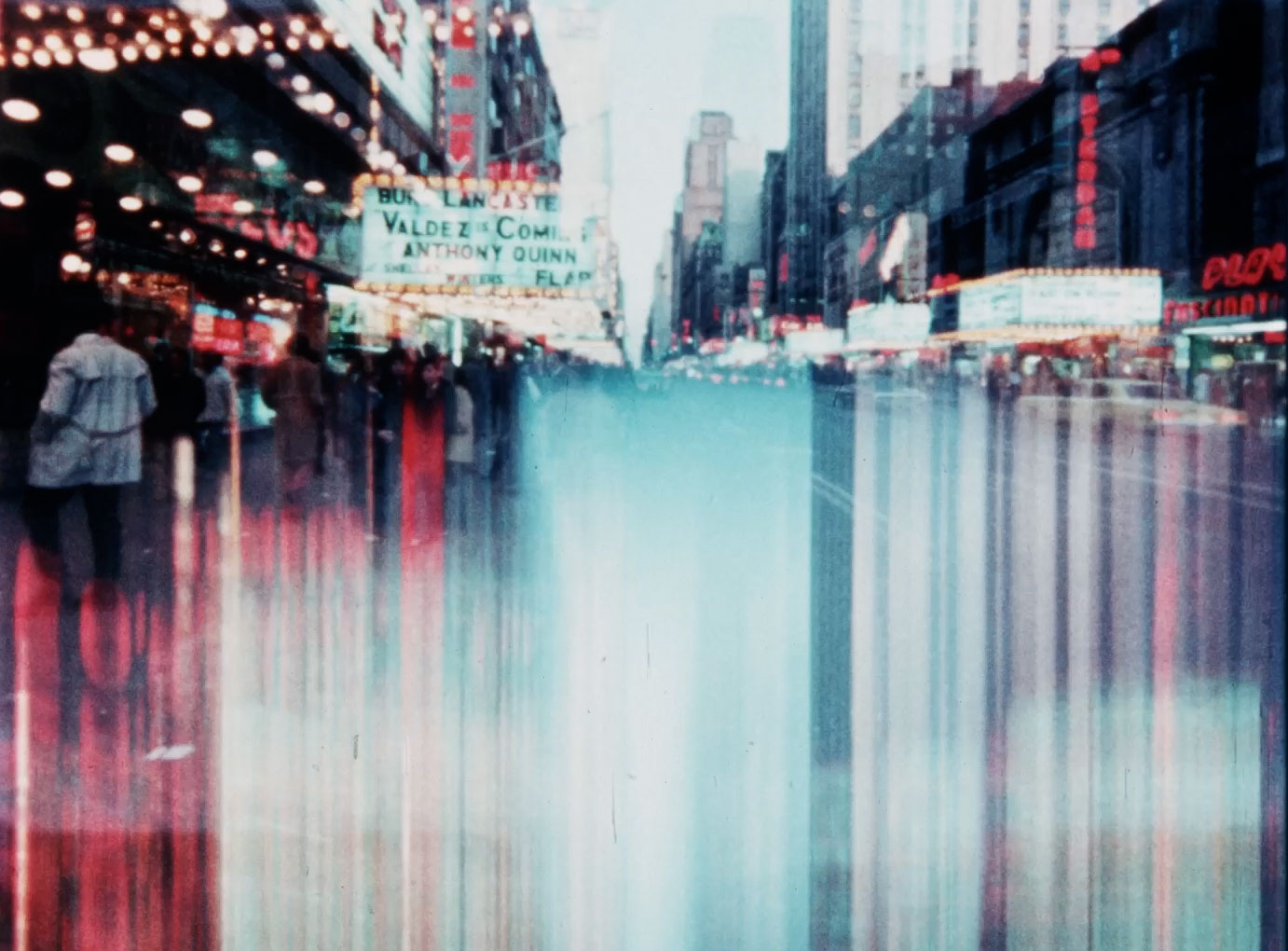
Alexis Krasilovsky was born in Juneau, Alaska in 1950, and grew up in Chappaqua, New York. While attending Smith College, she studied abroad in Florence, Italy, and, as she described it, “I just happened to come across some wild, crazy people my age who were making a film behind the Pitti Palace, and I got to participate in that. That was Sandro Chia,” the Italian painter and sculptor who later became known as a principal member of the Transavanguardia movement. In 1969, Krasilovsky transferred from Smith College to Yale University as part of the first cohort of women admitted to Yale, and was among the first class of graduates to include women, the class of 1971. Her interest in film, sparked in Florence, led her to enroll in a graduate filmmaking course taught by Murray Lerner, who had, five years earlier, made the Yale-focused documentary To Be a Man (preserved in 2016 by the Yale Film Archive). End of the Art World began as an assignment for Lerner’s course. In an interview in advance of a screening of the film in September, 2019, as part of a celebration of 50 years of undergraduate coeducation at Yale, Krasilovsky described the film’s origins:
I was the only—or one of the only—women studying filmmaking. The guys were mostly graduate students, as I recall. They would pick apart each others’ dailies ruthlessly; if you could survive these critique sessions, liberally peppered with words like “bullshit,” which at the time was new vocabulary for me, the quality of your film would toughen up. But no one gave me feedback in the class. I was invisible. That actually helped my film improve... If my film stands up to time, I have my fellow students’ cold shoulders and the books that Susan Sontag and Rudolf Arnheim wrote to thank, as well as Murray Lerner, who was kind enough to let me, a mere undergraduate, into his filmmaking class.
Looking back, the way I handled PTSD from being one of the first coeds at Yale was to apply to the Whitney Museum Independent Study Program. That allowed me to get college credit while spending a considerable amount of the Spring 1971 semester in New York instead of on campus. Michael Snow was assigned as my mentor. Meanwhile, however, I was lucky enough to be able to borrow a sync sound camera from D.A. Pennebaker, whose faith in me as a budding filmmaker went a long way towards validating my first efforts, no strings attached. I also took the money that my grandmother had given me to buy clothes to wear at Yale, and instead bought a 16mm Bolex, which I used to film Robert Rauschenberg in his studio as well as the Midwestern cows that I filmed to bi-pack in the camera as a special effect of cows walking through Warhol’s 1971 opening at the Whitney. My camera was stolen back at Yale, when I was editing. Warhol allowed me to be the only cameraperson, male or female, to film his opening at the Whitney Museum in 16mm. I almost didn’t finish making End of the Art World, having faced sexual assault while hitchhiking to the lab with the Warhol optical footage in my backpack. But fortunately, Prof. Jay Leyda admonished me that if I didn’t complete it, I would never become a filmmaker.
End of the Art World was included in the Whitney Museum’s first festival of films by women directors, overseen by curator David Bienstock in 1973. Writing critically about the upcoming Whitney series and two other festivals focusing on films by women in an article in Variety magazine, Krasilovsky quoted festival director Kristina Nordstrom, who said “I’m happy to see women’s films being shown. But a lot of these films belong in regular programs: ‘End of the Art World’ and ‘Growing Up Female.’ It’s a matter of taste. Maybe if David Bienstock were a woman, he’d feel differently.”
In a 1976 Los Angeles Times preview of a screening of the film held at the Theater Vanguard in Los Angeles, Kevin Thomas described the film thusly:
With ferocious wit, Ms. Krasilovsky sends up New York’s art scene in “End of the Art World” (1971). In essence, Ms. Krasilovsky uses the sounds and images of the usual art documentary to create her own work of art. In the process—or re-process—she satirizes the fatuity of the standard interview with the artist and by the end identifies art with revolution as she fantasizes the quite literal obliteration of the Metropolitan Museum’s 20th-Century art curator, Henry Geldzahler.
Thanks to a connection made by Robert Withers (the filmmaker behind the Yale Film Archive’s 2017 NFPF grant project, 16 Millimeter Earrings), Alexis Krasilovsky, now a Professor in the Department of Cinema and Television Arts at California State University, Northridge, reached out to the Yale Film Archive in 2016 about donating her collection. By 2019, her collected film work, previously divided among herself, ProTek film storage, and Canyon Films, was reunited at the archive.

To use aviary, please update your browser to the latest version
I understand the consequences
Go to Homepage